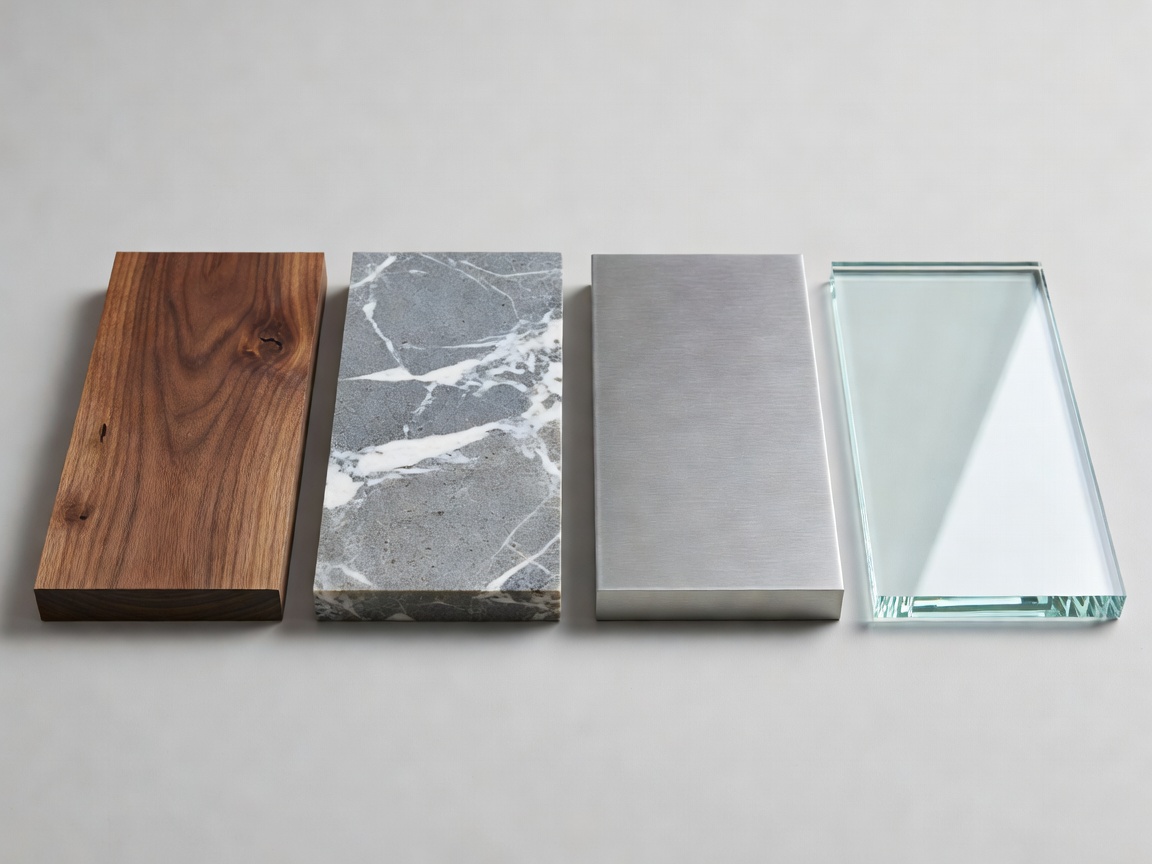
Timber
Oak has a visible grain and can be finished in pale, smoked or stained tones. Walnut often brings a deeper colour and strong figure. Ash has a pronounced grain and can read lightly when finished without heavy colour. Beech is usually close-grained and can suit turned or formed components. These are broad material descriptions, not fixed style rules.
Engineered wood categories include plywood, veneered board, medium-density fibreboard and other panel products. They can offer dimensional consistency or efficient construction, but the edge treatment and surface layer must be specified. Veneer direction, thickness, substrate and repair approach matter. Timber can move with changes in moisture. Construction should allow for that movement where relevant.
Stone and marble
Stone brings mass, mineral variation and a cool tactile quality. Marble can show veining, pores and tonal change. Ask about slab selection, edge profiles, sealing, staining, heat, impact and cleaning. A stone top may require a stronger substructure and a delivery route that can handle its weight. Never assume a sample represents the exact finished slab.
Metal and glass
Brass can be polished, brushed, darkened or allowed to develop a patina. Steel may be painted, powder-coated, brushed, blued or treated in another specified way. Finish names can mean different things between suppliers, so request a physical sample. Glass can be clear, tinted, textured, laminated or frosted. Confirm thickness, edge treatment, safety requirements and support details.
Leather, textile and upholstery
Leather varies by hide, grain, coating and finish. Textile selection should consider weave, light, abrasion, cleaning and seam direction. Upholstery materials also interact with foam, webbing, filling and frame geometry. Ask whether covers are removable and how replacement fabric is handled. A material suitable for a domestic chair may not suit a heavily used hospitality seat.
Finishes
Oil can emphasise grain and may support local maintenance, but it needs a clear care routine. Wax can alter sheen and feel while remaining sensitive to use. Lacquer creates a film whose sheen, colour and repair method should be defined. Stains change colour without necessarily changing the underlying grain. Painted finishes can be matte, satin or gloss and may conceal some substrate variation. Brushed metal and natural surface treatments depend on direction, handling and subsequent cleaning.
Combining materials
Good combinations account for movement, tolerances, contact, weight and maintenance. Timber beside stone needs a considered junction. Metal hardware can mark softer surfaces. Glass needs safe support and protected edges. Upholstery needs an interface that can be repaired. Select the material system with the workshop, then approve samples under the light of the intended room.
Match material to workshop → See when samples are approved →